
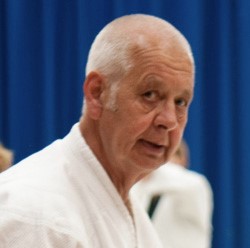
"That knowing look"

As well as Chiba Shihan and Abbe Sensei, Mr Spence trained with other significant Japanese Senseis travelling abroad to spread the teachings of Aikido. These included Senseis Tada, Sekiya, Kitaura, Nakazona and Tamuru.
Bob Sensei chuckles over a couple of stories about Abbe Sensei. Mr Mucha and Bob once collected him at Preston railway station. Abbe Sensei was wearing kimono, hakama, a bowler hat and carrying a furled umbrella. When Bob had bundled him into a taxi, he asked Abbe Sensei why he was wearing a bowler hat. "Because in England, gentleman carries umbrella and bowler hat. AND I GENTLEMAN !" Mr Spence didn't ask anything else.
They lost Abbe Sensei once, during a course at the Hut in West Drayton. They found him in a nearby field, standing on a horse, shooting arrows from a Kyudo bow. They didn't lose him again…
Reaching back to O'Sensei
Bob Sensei is one of the few who can almost reach back to touch O'Sensei. As a student of Chiba Shihan and other Japanese teachers, Bob Sensei is only once removed from the Founder. He has felt and absorbed this direct influence in several ways. But when asked whether any one particular teaching from O'Sensei stands out, Bob Sensei has an immediate answer.
O'Sensei placed great emphasis on the need to practice Aikido in order to understand it. Bob describes it in a simple phrase: "It is not the knowledge of the technique but how you perform it".
He expands on this. Knowledge of the technique is essentially physical – posture, position of the feet, the use of the hips. We are all taught these in class.
However, performance comes from a state of mind, which understands and accepts the feeling of the technique. This understanding frees up the harmony, the flow, the blending, all shown by the truly experienced Aikidoka. It is not really teachable.
The Grading Sheet aims to describe this blend of knowledge and performance as best it can. But it is more than words can explain – it is Aikido's "higher plane of consciousness".
Again, Bob Sensei illustrates it in a way we can recognise. He is often asked "what would you do if someone attacked you with …[choose here from a range of weapons or attacks]". Bob's answer is always the same – he doesn't know. And he emphasises that he does not need to know.
Instead, he has an absolute confidence in his ability to do something, an inner calmness and contentment that he can respond, without hardness or hurting. Of all the teachings Bob Sensei has absorbed from O'Sensei, this is the most persuasive.
As we discussed all this, something seemed to be missing. Part of Mr Spence's Aikido training was formal meditation. Students did it on courses in the early mornings and Chiba Shihan certainly considered it important. Did meditation help visualise how to improve one's Aikido ? Has it been neglected in these faster moving times ? Should it be brought back ?
The past is a foreign country…

Terry Ezra Shihan, 7th Dan (1945-2022), had studied Aikido for over 50 years.
Could any of these happen today ? Are we softer ?
Is our Aikido as good ?
Bob Sensei agrees that we have become softer but not much more.
He knows that most people have a job outside Aikido and families to support. It's simply not fair to put those needlessly at risk. Bob Sensei is equally sure that in a more compensation-aware society, he does not want to be sued !
He also reasons that both the British Aikido Board (BAB) and the Lancashire Aikikai have the right procedures and approach to offer hard rather than harsh training. Anyone in the Aikikai can see that our training can be challenging but is always matched to the abilities of the participants.
Of course, if any of us don't feel our training is "stimulating" enough, then ask a senior Dan grade to train as ki no nagare. Good luck.

Bob Sensei teaching at Ribby Hall, 2010
So, says Bob Sensei, why should our Aikikai be any different ? Whatever happens, he urges us all to remember the following:
○ Aikido is a martial art, not a sport. Look how different Judo has become.
○ It is a life skill coupled with an attitude of mind – a powerful blend.
○ Do not discard or forget the basics – they apply to all branches and schools of Aikido
○ Look back at the roots of Aikido and why it was developed by O'Sensei – these provide the compass for the whole Aikido journey
In Mr Spence's view, these must be the anchor points for the shape of any future Lancashire Aikikai.
This is not a view taken in isolation. Bob Sensei has been involved with the British Aikido Board (BAB) from its early days. Indeed, he set up the very first coaching scheme for the BAB and was their first Tutor of Aikido. Since 1991, he has assessed and accredited BAB teachers as the BAB's Coach Tutor for Levels 1-3.
So Bob Sensei sees many Associations in action and knows many senior Senseis across the country. He has watched some styles develop and some wither. So he can see that his own Aikikai compares well and is in fine shape for the future. We should all be grateful to him for this.
But Bob Sensei doesn't take his eye off the ball. He dislikes watching Aikido, much preferring to be practising. But sometimes he has to. So he'll always have a notebook with him, ready to scribble down comments on what he has noticed, good ideas he has seen and thoughts for the future. Bear that in mind for future courses….
Bob Spence Sensei, 6th Dan, BAB Coach Tutor, Head of Lancashire Aikikai – what else ?
As we have learnt, as a youngster Bob told his mother that his ambition was to end up in Barlinnie Jail. His mother said, "maybe you could be a teacher", so he said he would be a Headmaster. This didn't happen, but teaching has been a foremost part of his life.
He has shown that in the BAB and of course, the Lancashire Aikikai. But what many don't know is that Bob is heavily involved in coaching for the Amateur Swimming Association (ASA). So when he set up the BAB coaching scheme, he based it upon the ASA coaching structure that he knew worked well.
What else? Bob Sensei is a competent coffee barista offering his visitors tasty, specialist coffees. He has just started to learn the art of sushi. So there is even more to him than we see.
It's been quite a journey from Bob's childhood roots in Glasgow. He readily agrees that Aikido has helped him take the right path in life. I'm sure he no longer thinks Aikido to be a bunch of sissies led by a man in a black skirt.

Mr Mucha and Mr Spence in centre front, teaching a course at Hazel Grove.
Thanks to Hephzi Yohannan and Algy Cole for the article - Appeared in our October 2013 Newsletter
